
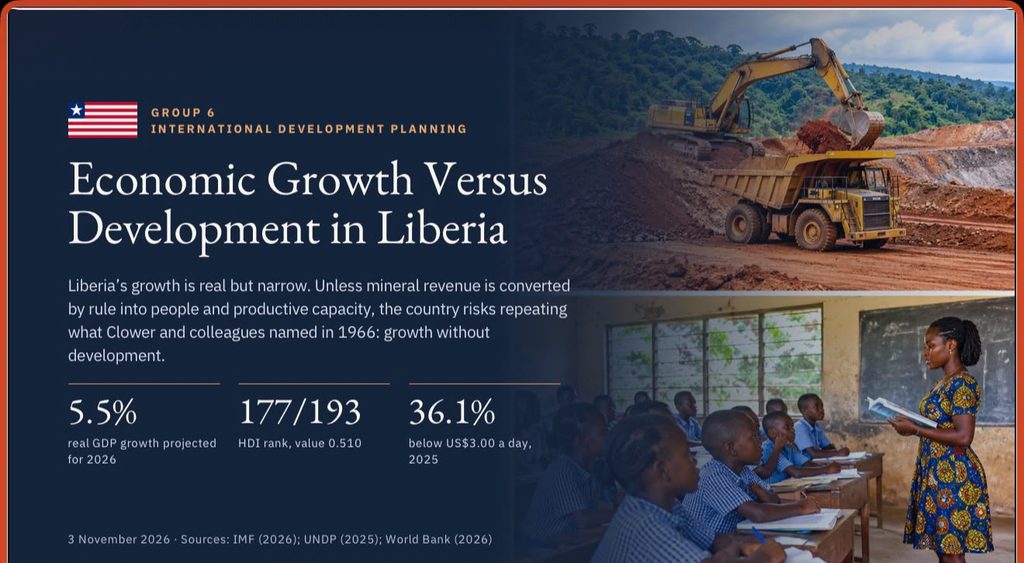
The Ore Rises, the People Remain
The International Monetary Fund says Liberia will grow by 5.5% in 2026. The figure will be read aloud in ministries, printed in press releases and repeated on the radio as proof that the country is moving. Somewhere in Gbarpolu, a mother who has never seen a functioning clinic will hear it too. She deserves to ask the only question that matters. Moving where, and for whom? On 3 November 2026, the World Bank answered her in its own careful language. Its seventh Liberia Economic Update, titled Beyond Growth, found that the economy grew 5.1% in 2025 while extreme poverty rose. Read that again. The economy expanded and more Liberians fell below the line. That is not a paradox. It is a system working exactly as it was built to work. Whose Growth Is It? Strip away the headline and look at where the 5.1% came from. Mining grew 17% in 2025. Iron ore output rose about 42%. Agriculture, where most Liberians actually earn their bread, grew only 2.6%. Manufacturing outside mining shrank by 2.8%. So the growth did not rise from the farm, the market stall or the workshop. It rose from the pit. It was dug out of Liberian soil, loaded onto trains and ships, and counted in Monrovia as national progress. Now measure the people instead of the ore. Real GDP per person stood at US$717 in 2013. It fell to US$605 in 2020 and reached only US$684 in 2025. After 12 years, the average Liberian is still poorer in real terms than before the Ebola crisis. The employment rate is projected to sit frozen at 74.4% from 2023 all the way to 2028. Output climbs. Jobs do not move. This is what economists politely call narrow growth. Let us call it by its proper name: growth that belongs to capital, financed by the land of the people. We Have Been Here Before In 1966, Robert Clower and his colleagues studied Liberia and gave the world a phrase it still uses: growth without development. They found a country posting some of the fastest growth rates on earth while its people remained excluded. Foreign concessions in iron ore and rubber produced wealth in enclaves sealed off from the rest of the nation. The profits sailed out. The roads, schools and wages stayed behind in promise only. 60 years later, the World Bank describes the same structure in softer words. Mining is capital intensive and has produced few jobs. Sizable income outflows, the profits and service payments that leave the country, offset much of the export gain. GDP therefore overstates what Liberia truly keeps. The enclave never died. It changed its flags and its letterheads. The concession economy that the True Whig oligarchy managed for foreign capital in the last century is alive in this one, and the poor still stand outside the fence watching the trains go by. The Farmer, the Child, the Mother More than half of poor Liberians depend mainly on farming. The World Bank estimates that the share of Liberians living below US$3.00 a day rose from 34.6% in 2024 to 36.1% in 2025. That is in the very year the economy was celebrated. The farmer was not invited to the boom. She was handed the inflation. Walk into the classroom. Liberia’s children receive about 10.5 expected years of school, yet the Human Capital Index credits them with just 2.2 years of real learning. Officials reported in December 2025 that 2 of every 3 Grade 3 pupils cannot read a simple story. A nation that cannot teach its children to read is not developing, whatever its export figures say. Walk into the maternity ward. 628 women die for every 100,000 live births. 26.3% of children are stunted. Only 23.3% of the population has basic sanitation. More than half of Liberians are multidimensionally poor. And look at the map. Grand Bassa, the county that hosts the iron ore railway and port, ranks 13th of 15 on the Human Development Index. The county that ships the wealth is among the poorest in the Republic. There is no clearer indictment of the concession model than that single fact. Development Is a Class Question We are told that poverty is a technical problem awaiting the right consultant. It is not. Poverty in a resource rich country is a question of power: who owns the wealth, who writes the contracts, and whose needs the budget is designed to serve. Amartya Sen taught that development is the expansion of real freedoms. Dudley Seers asked the simplest test of all: what has happened to poverty, to unemployment, to inequality? By that test, a growth model in which ore leaves, profits leave and jobs never arrive is not development. It is extraction with a statistical department. Consider the choices already made. ArcelorMittal’s US$200 million signature bonus equals about 3.5% of GDP, yet the draft FY2026 budget assigned only about US$13.75 million of it to education. Capital spending fell from 8.2% to 5.3% of GDP. These are not acts of nature. They are political decisions, and every one of them reflects whose voice carries in the corridors where money is divided. When the mineral wealth of a people is spent on recurrent consumption by the state, the nation is eating its seed rice. When it is surrendered cheaply to foreign capital, the nation is giving away its land. Either way, the working people of Liberia pay the bill. The Demand: The Ore Belongs to the People The answer is not charity and not another donor workshop. It is a law. Liberia needs a statutory Mineral Revenue Development Compact that treats every dollar of royalties, mining taxes and signature bonuses as the capital of the people, never as pocket money for the state. When ore is sold, the proceeds must become another asset. The scarcest assets this nation has are the minds of its children and the productive power of its counties. The Compact would bind mineral revenue to 2 windows only: The people first. Foundational learning, primary health care and child nutrition, with the largest share going to the counties at the bottom of the HDI table: Gbarpolu, Grand Bassa, Grand Cape Mount and their neighbors. The means of production. Feeder roads, irrigation and storage for smallholders; agro processing in rice, cassava, rubber, cocoa and fish; certification of Liberian suppliers so that mining contracts buy Liberian goods and hire Liberian hands. And because power concedes nothing without accountability, the Compact must be watched by the people themselves. Ghana’s Public Interest and Accountability Committee shows that citizens can audit petroleum money. Botswana shows that mineral wealth can be booked as investment in human beings. Liberia should publish results every quarter, county by county, by sex and by age: Grade 3 reading, maternal deaths, child stunting, local jobs, smallholder yields. …